
The toughest men I've read about took off the mask
Oct 13, 2026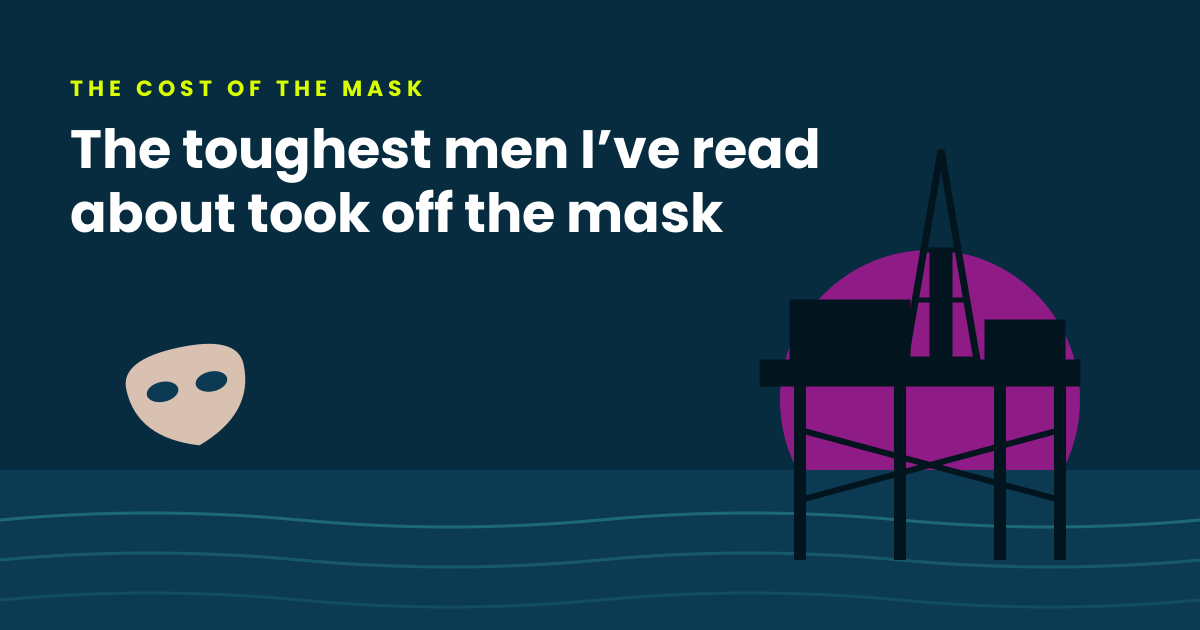
Okay, picture this with me for a second. You're on a helicopter heading more than 100 miles out over the Gulf of Mexico, and when you land, you're standing on an offshore oil platform, which is about as rough and tough and manly a workplace as you can imagine. People out there work twelve-hour shifts, sleep in bunk rooms for two weeks at a time, and do the kind of work that can kill you if somebody gets careless.
That's exactly where Harvard professor Robin Ely and Stanford's Debra Meyerson decided to go back in the early 2000s. They ate in the cafeteria with the crews, slept in the bunks, asked a whole lot of questions, and came home with a paper called Unmasking Manly Men, which, I mean, come on. If you've been around me for any length of time, you know I couldn't have named it better myself.
You can probably guess what they expected to find, because researchers had already seen it in coal mines and fire departments for years. In dangerous jobs, men tend to work really hard at looking invulnerable. They show off around danger; they never admit they don't know something or that they messed up, and they keep their feelings locked way down. The problem with all that performing is that it gets people hurt, because when you hide a mistake nobody learns from it, and on an oil rig a little hidden mistake can turn into a big disaster.
But this company had done something different. They'd rebuilt the whole culture around safety and learning, and the men on those platforms had kind of quietly set the armor down. They'd say out loud when something was too heavy to lift alone. They'd own their mistakes in front of the crew so everybody could learn from them. They actually paid attention to how they were feeling and how the guy next to them was feeling. Ely called it purposeful vulnerability, and it was anything but soft, because the company's accident rate dropped 84 percent, and over that same stretch its production, its cost per barrel, and its uptime all got better than the industry's previous benchmark.
Ely said the problem was never toughness or strength or focus, because you need every one of those on an oil rig, and honestly you need them in a boardroom too. The problem was trying to prove them, putting on a show of them for everybody watching. Once those men stopped proving and just did the work in front of them, the very same qualities that used to get people hurt started keeping everybody safe.
(This study is one of the stories I tell in my keynote, Switch On Your Light, so if your leadership team needs to hear it, you can see what that looks like at karabundedunn.com/speaker.)
That's masking, friends. It was never about being strong or being soft. It's about whether your energy is going into being who you are or into proving who you think you're supposed to be.
I know this one from the inside. Years ago I was leading sales at a company that was really struggling, and when budget season came around I built the most honest forecast I could and handed it over. It came right back to me with one sentence attached: we can't give that to the board. I made my case for why we should, I really did, and out loud I said, okay, put a different number in there, and we'll find a way to get to it. Then I watched the CEO stamp that prettier number and send it up the chain, and everything inside of me was screaming that this wasn't right, and I let him.
We missed it, of course, even after throwing everything we had at it, and in the end we had to lay people off. I still believe that could have been prevented if we'd been honest from the start and built a real plan the whole executive team could get behind. That's the part of performing nobody likes to talk about. It isn't only a bad number that travels up the chain; it's the quiet moment where a room full of smart people overrules what they know so everyone can keep pretending, and somebody else ends up paying for it.
If I were sitting in that room today, I'd say it plainly: based on what we're doing right now, that is not a realistic number. And then I'd say the part that matters just as much, which is that if that's the number we truly need, I'm all in, but it means we brainstorm every new way we could bring in revenue and we all commit to doing things differently, because running the same play again next year is not going to get us there. I'd be the loudest advocate in the room for that plan. What I wouldn't do anymore is nod along to a number I don't believe in, and I stand by that.
Ely and Meyerson pointed to three things that made the shift possible: a purpose bigger than anybody's ego, a crew where owning a mistake didn't get you punished, and a definition of being good at your job that had nothing to do with acting tough. And none of that needs an oil rig, does it? Every team you've ever been on could use all three.
So this week I'd love for you to try something small with me. Catch yourself one time proving instead of doing, just once, and notice what it feels like to set it down for a minute.
Kara
P.S. I'm booking keynotes right now for leadership retreats, team kickoffs, conferences, and annual meetings. If your team has a gathering on the calendar, head to karabundedunn.com/speaker and let's talk about bringing this conversation into your room.
Stay connected with updates!
Join our mailing list to receive the latest updates and information.
We hate SPAM. We will never sell your information, for any reason.